About this resource
This application is a companion resource for the PrecisionTox Chemical Library publication. It helps users explore the
rationale, classifications, and collected annotations for a curated set of 200 chemicals selected to support
phylotoxicology and new approach methodologies.
The PrecisionTox Chemical Library
This chemical collection was designed to discover evolutionarily conserved
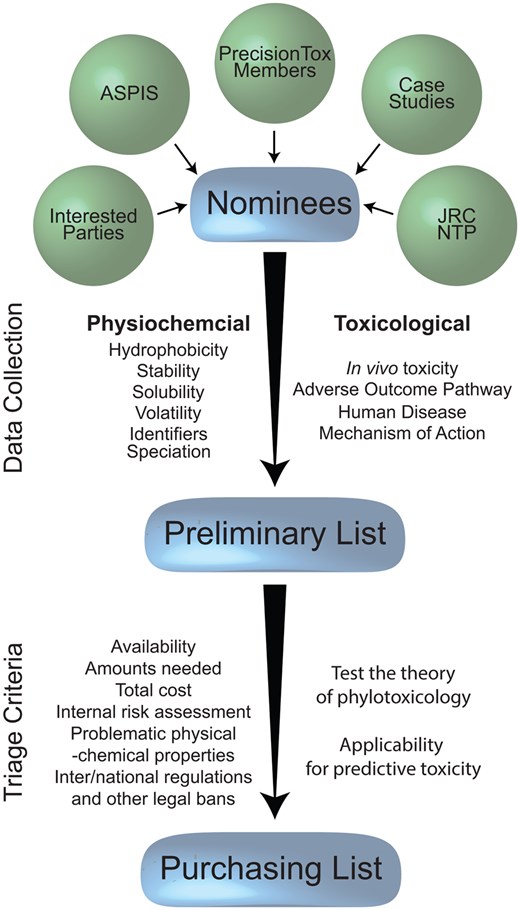
biomolecular signatures of toxicity as part of the PrecisionTox project. From an initial pool of more than 1,500 nominees, 200 chemicals were selected
using multiple criteria, including organ toxicity, environmental exposure, chemical structure, modes of action,
toxicological relevance, and practical testing constraints such as availability, purity, cost, and shipping.
Unlike libraries focused on a single disease target or receptor interaction, the PrecisionTox collection prioritizes
diversity in targets and mechanisms of toxicity. This makes it useful for evaluating toxicity prediction approaches,
refining toxicological models, and supporting hazard identification for human and environmental health protection.
PrecisionTox Project
PrecisionTox is an EU's Horizon 2020 project that
aims to promote alternative methods to animal testing for chemical safety assessment. It proposes to establish causation between chemicals
and their adverse health effects by testing the concept of phylotoxicology: the idea that many biomolecular and toxicological responses to
chemical exposure are shared across distantly related species through evolutionarily conserved processes and pathways.
The collection supports omics-based toxicological studies across alternative test models and provides a shared data
resource for exploring chemical diversity and biological response.
What You Can Explore
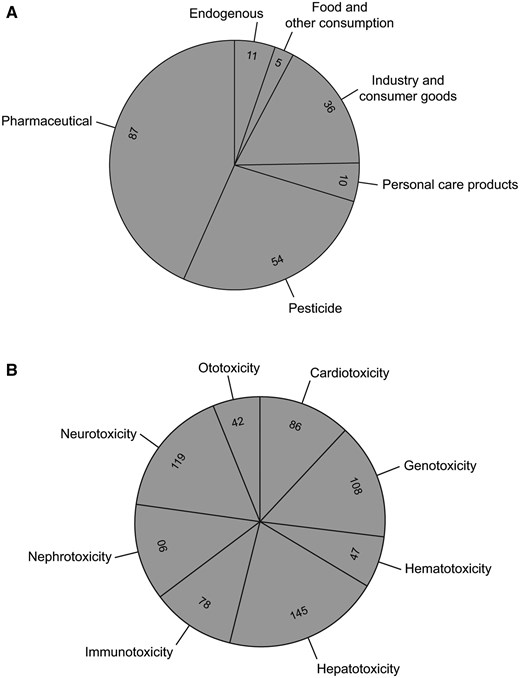
- Use and toxicity endpoint classifications.
- Individual chemical networks with collected annotations.
- A searchable full table of the chemical collection.
Collected Information
- Physicochemical properties.
- Text-mined toxicity classifications.
- ADME-related information.
- Baseline toxicity data (in C.elegans, D.melanogaster, D.rerio, X. laevis, D.magna and HepG2 cells).
- Mechanisms of action, targets, and adverse outcome pathways (from Drugbank, T3DB and AOP-Wiki).
Cite
The PrecisionTox chemical library: creation of a chemical collection to discover evolutionary conserved biomolecular
signatures of toxicity. Rubén Martínez, Juan Carlos González-Sánchez, Stavroula I Sampani, Stefan Scholz,
Beate I Escher, Luise Henneberger, Julia Huchthausen, Maurice Whelan, Thomas Dickmeis, Carsten Weiss,
John K Colbourne, Jonathan H Freedman, Toxicological Sciences (2025).
kfaf126.
Contact
Juan Carlos González Sánchez - juan-carlos.gonzalez@bioquant.uni-heidelberg.de